Meet Neo, your AI-powered Co-GP.

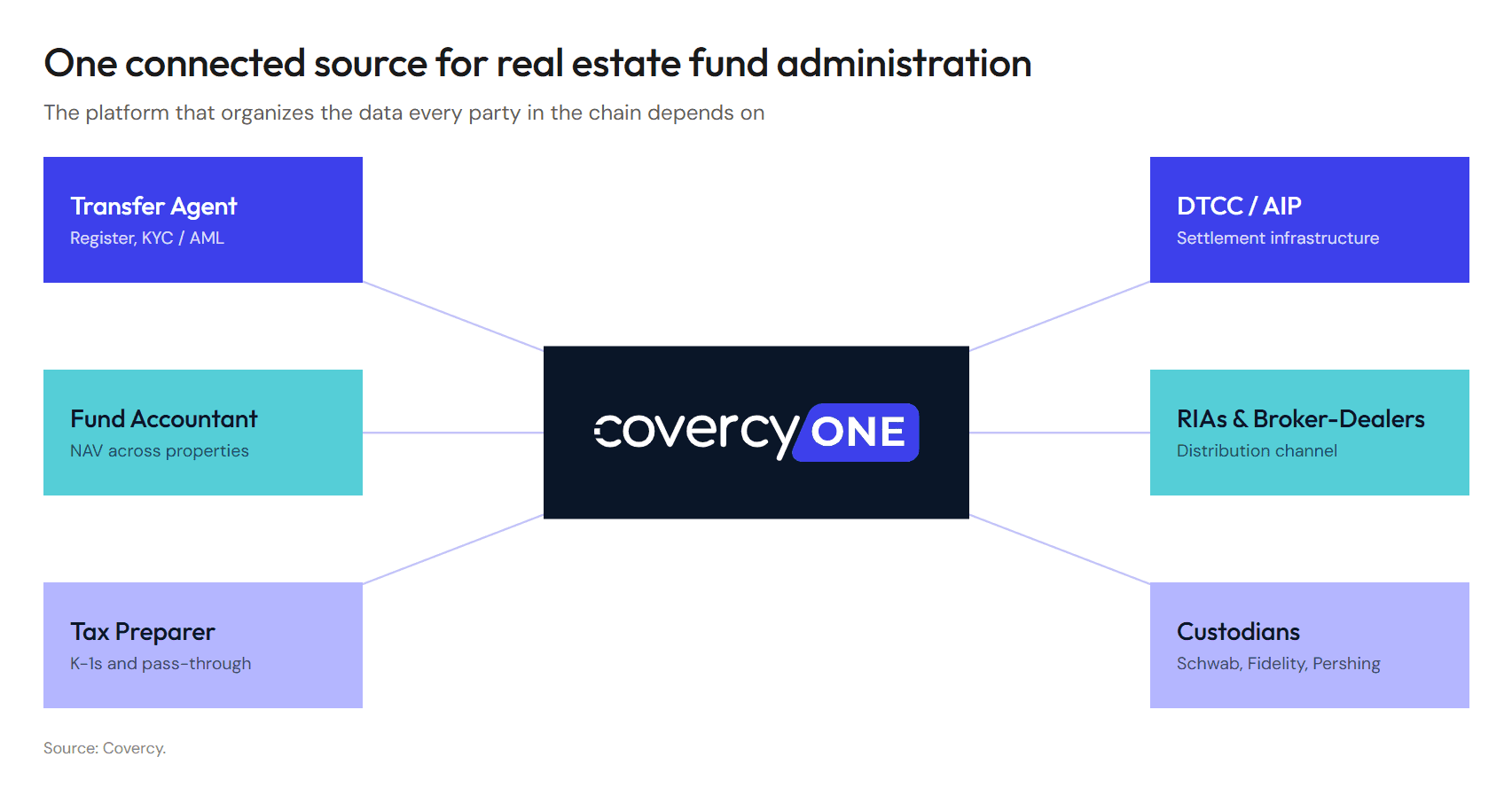
Count the parties involved in administering a single real estate fund. There is the GP — the sponsor — who owns the investor relationships and the deal terms. There are the LPs, who want their capital account statements, their distributions, and their K-1s on time. There are the broker-dealers and RIAs bringing in clients, and the custodians — Schwab, Fidelity, Pershing — those clients hold their accounts with. There is the transfer agent maintaining the official shareholder register. There is the fund accountant calculating NAV across the fund's properties. There is the tax preparer assembling K-1s. And sitting underneath the whole RIA channel, there is DTCC, the settlement infrastructure most wealth managers require before they will allocate a dollar to your fund.
Every one of those parties needs the same underlying data — who invested, how much, into which assets, on what terms, and what they have been paid. And in most real estate fund operations, every one of them holds a slightly different copy of it, in a slightly different format, updated on a slightly different schedule. That is the fund admin mess. It is not that any single party is doing a bad job. It is that the data has to be reconciled across all of them, by hand, every time a deal closes, a property refinances, or a distribution goes out.
This post is about where that mess comes from in a real estate fund specifically, what it costs the sponsor, and what it looks like to clean it up by connecting the data once instead of reconciling it forever.
The mess is in the handoffs, not the work
Each party in a fund's operation does competent work inside its own system. The transfer agent runs a clean shareholder register. The fund accountant produces an accurate NAV. The tax preparer files correct K-1s. The problem is not the work; it is the space between the work.
A subscription comes in on the new multifamily fund. The sponsor's CRM records the commitment. That commitment has to be re-keyed for the transfer agent to process the subscription and run AML/KYC. The transfer agent's register then has to feed the fund accountant so the LP's capital account ties out against the fund's property-level performance. The fund accountant's numbers have to reach the tax preparer at year-end, complete with the depreciation and pass-through items real estate generates. And if any of those investors came through an RIA, the position has to flow through DTCC so it shows up on the custodian's statement. Every arrow in that chain is a handoff, and almost every handoff is a spreadsheet emailed between two parties who keep their own records.
The mess compounds because the data is never wrong in one place — it is wrong in the differences between places. The sponsor shows a commitment the TA hasn't processed yet. The fund accountant's NAV reflects a distribution the investor portal hasn't published. The K-1 lands in March built on books that were reconstructed from scratch in February because nobody kept the investor-side accounting current while the team was busy closing deals. None of these is a catastrophic error. Together they are a permanent, low-grade tax on the operation.
What the disconnection actually costs
The cost shows up in four places, and real estate sponsors feel all four.
Time. Someone on the team spends their week as a human integration layer — exporting from one system, reformatting, emailing it to the next party, fielding the reply that says the numbers don't tie, and chasing down which version is right. That work scales linearly with investor count and asset count, which is exactly the wrong way for work to scale when you're adding deals.
Errors. Every re-keying is a chance to transpose a number, miss a transfer, or pay a distribution on a stale ownership percentage after a property sells. In a chain with five or six parties, the error doesn't have to be anyone's fault to still be the sponsor's problem.
Investor trust. The LP doesn't see the back office. They see a capital account statement that disagrees with their last distribution notice, a K-1 that arrives late ahead of their own filing deadline, or a fund position that never showed up on their Schwab statement because the DTCC feed was built on a manual file. To the investor, a data-handoff failure looks like a sponsor who isn't on top of their fund.
Speed at the edges. When an RIA wants to bring clients into the fund, or an institutional LP requires third-party administration for governance, the sponsor who can't produce clean, connected data quickly loses the allocation. The mess doesn't just slow you down internally — it caps who you can raise from, right when real estate sponsors are working harder than ever to fill larger equity checks.
Cleaning it up means connecting the data once
The fix is not a better spreadsheet or a more disciplined email cadence. It is structural: the data should live in one place, organized once, and every party should draw from that same source instead of maintaining a private copy.
This is the difference between the traditional fund admin model and an integrated one. The traditional model is a back-office processor: you send a fund administrator data from your various systems, they process it in theirs, and you still operate a separate investor portal, a separate payments process, and waterfalls that live in a spreadsheet somewhere. The administrator's output is only as good as the fragmented inputs you fed it, and your investors still see a patchwork of vendors.
Connecting the data once flips the order of operations. You organize the investor records, cap table, deal terms, and transaction history first — in the platform the sponsor actually runs the fund on — and then the administrative services plug into that organized foundation. The transfer agent's register, the fund accountant's NAV, the tax preparer's K-1 data, and the DTCC feed all draw from the same source of truth rather than from six reconciled copies of it.
How Covercy One connects the chain
Covercy One is the investment management platform built for commercial real estate GPs, and it's built on exactly this premise: investment management first, fund administration integrated. The sponsor runs fundraising, the investor portal, capital calls, distributions, and banking on one platform — so by the time fund admin services are needed, the data they require is already clean and structured.
From that foundation, the administrative layer connects every party in the chain:
The transfer agent — delivered by Covercy Fund Administration — handles subscriptions, redemptions, AML/KYC, and the official shareholder register, and it syncs directly to the Covercy One cap table. The sponsor isn't re-keying commitments into a separate TA system; the register and the platform are the same record.
Fund accounting and NAV are built on Covercy One's organized transaction history rather than on files assembled at quarter-end. Because the waterfall calculations and distribution payments already happened in the platform — across the fund's properties and their specific deal terms — the accountant receives results, not raw material to interpret.
DTCC / AIP connectivity gives the sponsor the standard pipe that broker-dealers, RIAs, and custodians use for alternative investments. Positions flow from the fund through Covercy Fund Administration and DTCC onto Schwab, Fidelity, and Pershing statements automatically — clean electronic feeds instead of manual spreadsheets — and those feeds are synced to the same Covercy One investor records everything else draws from.
K-1s and tax support benefit from books that stayed current all year. Real estate K-1s are not simple — depreciation, pass-through items, and property-level allocations make them some of the more involved filings an LP receives. Because the investor-side accounting never went stale, the tax preparer isn't reconstructing it in February, and K-1s reach investors faster, delivered straight through the portal they already use.
The investors see one professional experience: real-time capital accounts, complete transaction history, the documents tied to each property, and K-1s in a single investor portal — not a stitched-together view assembled from several vendors' outputs.
The point is not that any of these services is new. Transfer agents, fund accountants, and DTCC have existed for decades. The point is that when they all read from one organized source instead of trading reconciled copies, the handoffs that create the mess simply stop existing.
What changes for each party
When the data is connected, every party in the chain does less reconciliation and more of its actual job. The sponsor stops being the integration layer and gets the time back for deals. The transfer agent works from a register that's already in sync. The fund accountant builds NAV on clean inputs. The tax preparer — or the sponsor's own CPA — works from books maintained year-round rather than rebuilt at year-end. The RIAs and custodians see positions on their own statements without anyone emailing a file. And the LP, at the end of all of it, sees a fund that looks as organized as it actually is.
That last one is the quiet payoff. Operational cleanliness is invisible when it works and glaring when it doesn't. The sponsor who has connected the data isn't just saving hours — they're presenting, to investors and to the wealth-management channel, the kind of buttoned-up operation that wins the next allocation.
The takeaway
The fund admin mess is a data problem wearing an operations costume. The parties aren't the problem and the work each one does isn't the problem — the reconciliation between them is. As long as the sponsor, the transfer agent, the fund accountant, the tax preparer, the broker-dealers, and DTCC each maintain their own copy of the truth, someone has to spend their life making those copies agree.
Connect the data once, at the source, and the whole chain gets simpler at the same time. That's the model Covercy One is built on for real estate funds: organize the investment management first, then plug professional fund administration into a foundation that's already clean.