Meet Neo, your AI-powered Co-GP.

Every piece of software a GP uses now ships with AI. The fundraising CRM has a writing assistant. The accounting tool categorizes transactions on its own. The investor portal offers to draft LP updates. Most of it is genuinely useful. The pace of adoption has just outrun the questions — and that gap closes with a short conversation with each vendor.
That data is what makes this worth doing carefully. A GP running a fund holds some of the most sensitive personal information a small business ever handles: investor Social Security numbers and tax IDs, bank account and routing numbers, accredited-investor financials, copies of driver's licenses and passports from KYC checks, and the full distribution history of every person who trusted the GP with their capital. When an AI feature processes any of that, the data can flow through more parties than the login screen suggests — and the GP is the one accountable for that chain.
Investment management sits close enough to banking that the stakes here are higher than in most industries — and that is exactly why GPs who adopt AI well now become the trusted operators in their cohort. This guide covers how to do that: what to do, what to avoid, and the specific questions to ask any vendor whose product has AI baked in.
Why PII in fund operations is a special case
Personally identifiable information is any data that can identify a specific person, either on its own or combined with other data. In a fund context, the obvious items are tax IDs, bank details, and government-issued documents. The less obvious items matter too: an investor's name attached to their commitment amount, an email address tied to a distribution schedule, or a phone number linked to a capital call notice. All of it can identify a person and reveal something private about their finances.
Three things make this category sensitive for GPs specifically.
First, the data is concentrated and high-value. A single fund's investor list is a compact file of exactly the information identity thieves and fraudsters want most. There is no low-value PII in a subscription document.
Second, the relationship is fiduciary. LPs consented to investing with a GP they trust — not to having their tax ID processed by services they were not told about. The trust is the asset on both sides of the table, and protecting it is part of the fiduciary duty.
Third, the regulatory surface is real even when it feels distant. Depending on the fund's structure, investors, and jurisdictions, a GP may be touching obligations under privacy laws like the GLBA in the United States, state laws like the CCPA, and the GDPR for any European investors. Fund administrators often carry SOC 2 examinations precisely because their clients need assurance about data handling. AI features do not get a pass on any of this. If a tool sends investor PII to a model, that transfer is subject to the same rules as any other data processing.
How AI tools actually handle your data, and why it matters
To vet a tool, it helps to know what generally happens when an AI feature processes data. There are a few patterns, and they carry very different risk.
Some tools send your data to a third-party model provider's API for processing and do not retain it or train on it. This is common and can be done safely, but it means your investor data is leaving the vendor's environment and traveling to another company. You want to know who that company is and what their terms say.
Some tools run models in their own infrastructure, so the data never leaves their environment. This reduces the number of parties involved, though it places more weight on that single vendor's security posture.
Less commonly, some tools use customer data to train or improve their models. This is the pattern to watch for most carefully, because it can mean fragments of your investor data become part of a model that other customers interact with. Reputable enterprise vendors generally contract this away, but consumer-grade and free tools often do the opposite, with terms that grant broad rights to use submitted content.
The reason this distinction matters: an AI feature is rarely self-contained. It is usually a chain. The vendor's software calls a model provider, which may run on a cloud host, which may have its own subprocessors. Each link is a place where data handling matters. Vetting the tool means understanding the whole chain, not just the logo on the login screen.
What to do
The good news is that vetting is straightforward once you know what to ask. None of these steps require a security background — they require the same operator discipline GPs already apply to lender diligence and fund admin selection.
Inventory where PII already flows. Before evaluating any new AI feature, know which of your current tools already touch investor PII and how. Most GPs are surprised by the answer. The CRM, the e-signature tool, the accounting system, the bank portal, and the tax preparer's software all hold pieces of it. You cannot govern what you have not mapped.
Read the data processing terms, specifically the AI clause. Vendors increasingly publish a data processing addendum (DPA) and, separately, terms covering AI features. Find the sentence that says whether your data is used to train models. If you cannot find that sentence, that absence is itself an answer, and you should ask the vendor directly in writing.
Ask for the subprocessor list. Any serious B2B vendor maintains a list of the third parties it shares data with, including model providers and cloud hosts. Ask for it. The list tells you who is actually in the chain and lets you check whether those parties are themselves reputable.
Require data minimization. The safest PII is the PII the AI never sees. Prefer tools that let you control what data a feature can access, that redact or tokenize sensitive fields before processing, and that keep AI features scoped to the task rather than given blanket access to your whole investor database.
Verify the security baseline. For anything banking-adjacent, a SOC 2 Type II report is close to table stakes. Ask for it. Encryption in transit and at rest should be standard. For European investors, confirm the vendor can support GDPR obligations, including data residency if relevant.
Keep a human in the loop on anything that moves money or goes to investors. An AI draft of an LP update is fine to start from. An AI-initiated wire is a different category of risk. The closer a feature gets to money movement or external communication, the more a person should review before anything is final.
Put it in writing with your investors and your own policies. Update your privacy policy and your LP communications to reflect how you actually use AI and what protections are in place. Investors are increasingly asking. Being able to answer clearly is a competitive advantage in fundraising.
What not to do
Do not paste investor PII into general-purpose consumer AI tools. The free chatbot is the most common place investor data ends up outside contracted systems. Dropping a subscription document or a distribution spreadsheet into a consumer-grade assistant to "clean it up" can mean that data is retained or used for training under terms nobody read. Keep investor PII inside vetted, contracted business systems.
Do not assume an enterprise logo means enterprise data terms. A well-known vendor can still have a free or low tier with permissive data terms. The protections often live in the paid plan or the negotiated contract. Confirm which terms apply to the plan you are actually on.
Do not treat "we use AI" as a feature to celebrate without asking how. A vendor that markets AI heavily but cannot explain where data goes is telling you something. The good vendors find these questions easy to answer because they have already done the work.
Do not let shadow AI accumulate. When individual team members each adopt their own AI tools without review, the fund ends up with investor data scattered across services nobody is tracking. Decide as an organization which tools are approved for which data.
Do not over-rotate into doing nothing. The opposite failure is also real. Refusing all AI to avoid the data question leaves a GP slower and more manual than peers who adopted carefully. The goal is governed adoption, where the useful features are used and the data is protected at the same time.
A practical vetting checklist for AI-embedded software
When you are evaluating a tool with AI features, work through these questions with the vendor. Get the answers in writing where you can.
- What data does the AI feature access, and can we limit its scope?
- Is our data sent to a third-party model provider, and if so, who?
- Is our data ever used to train or improve any model? (You want a clear no, in the contract.)
- Is data retained after processing? For how long, and can we require deletion?
- Who are your subprocessors, and can we see the current list?
- Do you hold a SOC 2 Type II report, and can we review it?
- Is data encrypted in transit and at rest?
- Can you support GDPR and data-residency requirements for our European investors?
- What happens to our data if we leave? How is it returned or destroyed?
- Is there a human review step for any AI action that moves money or contacts investors?
A vendor who answers these readily is one you can probably trust with investor data. A vendor who deflects, delays, or treats the questions as unusual is showing you the answer in a different form.
How this plays out in investment management and fund admin
The reason these questions land harder in fund operations than in, say, a marketing tool is that the data and the money sit in the same systems. An AI feature added anywhere in the stack inherits the data exposure of that whole arrangement.
Most sponsor tech stacks are four to six disconnected vendors — fundraising in one place, banking in another, distributions in a spreadsheet, investor records in a CRM. Every connection between those systems is a handoff where PII moves, and every handoff is something to govern. The GPs we work with on Covercy One run fundraising, investor records, banking, and distributions on a single platform where banking and payments are native rather than bolted on. Fewer systems holding investor PII means fewer vendors to vet, fewer subprocessor lists to chase, and fewer chains of parties to account for. It does not remove the need to ask the questions in this post — it cuts the number of vendors you have to ask them of.
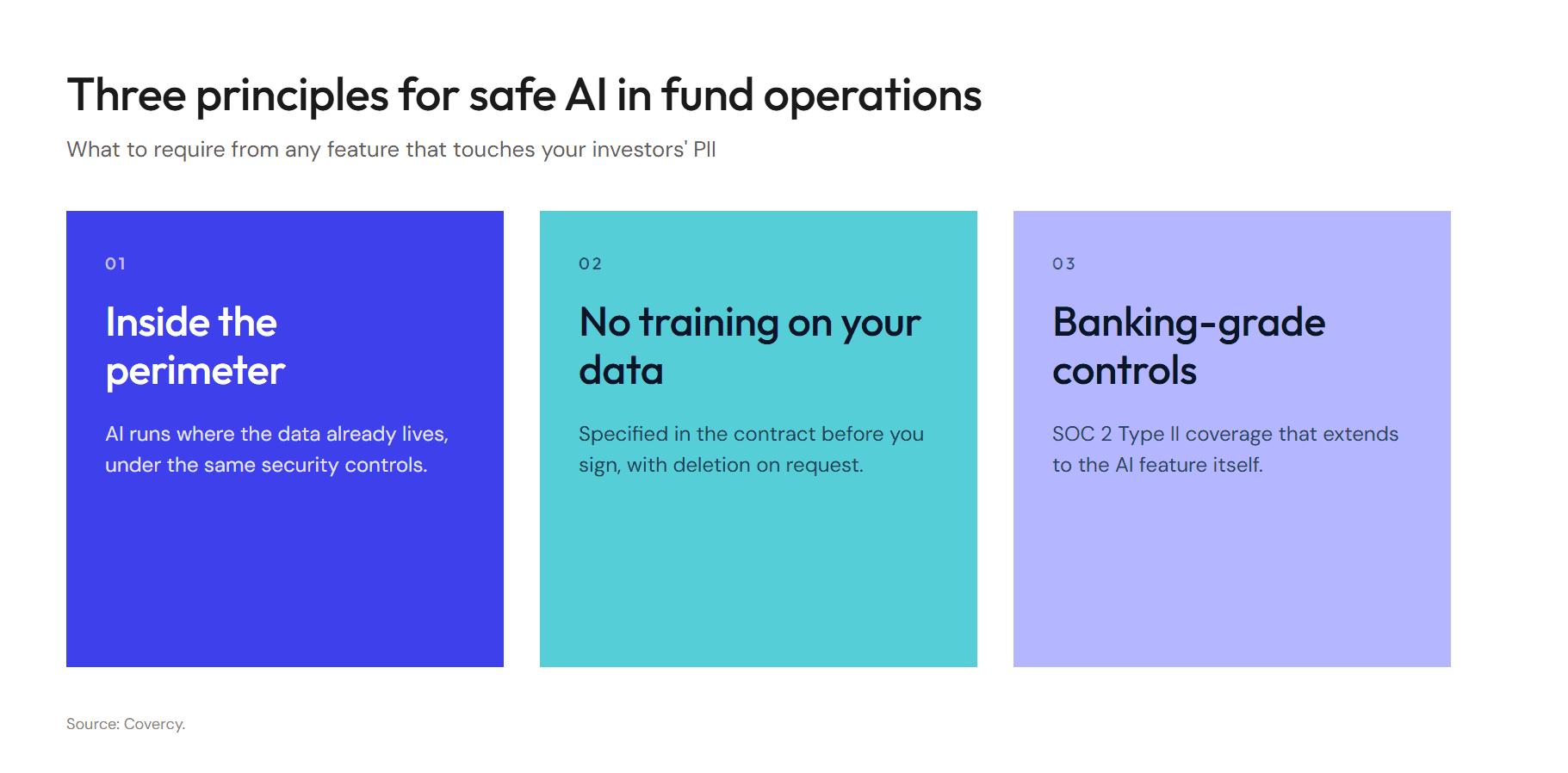
The same principle shapes how we built AI into the platform. Neo, the AI Co-GP inside Covercy One, runs in the same governed environment that already holds the data — under the same SOC 2 controls, the same encryption, the same permissions. Neo can only see what the user calling it can see. The chain of parties does not get longer when you turn AI on. That is the bar we think every AI feature in fund operations should meet.
AI in fund operations is worth adopting, and the firms that adopt it carefully will move faster than the ones that either ignore it or use it recklessly. The deciding factor is whether the GP treats investor data as the fiduciary responsibility it is and asks the vendor the questions that responsibility demands. The tools that deserve your investor data will have good answers ready.