Познакомьтесь с Neo — вашим Co-GP на базе ИИ.


If you use Carta for fund administration and are weighing other options, the main alternatives are AngelList, Gen II Fund Services, Juniper Square and Covercy, listed below in alphabetical order. AngelList is built around venture funds and syndicates. Gen II is an outsourced administrator with its own investor technology. Juniper Square and Covercy each pair a platform with a fund administration team, and both serve real estate managers. The question that decides between them is what kind of fund you run: a venture or private equity fund, or real estate deals and funds with property-level waterfalls, preferred returns and regular distributions to investors.
What Carta is and who it fits
Carta is a software company for private companies and private funds. Its help center covers equity management for companies (issuing equity, managing stakeholders and 409A valuations) alongside fund administration, LP Portfolio Analytics and Carta CRM, which it describes as a single, AI-enabled platform for deal flow, LP relationships and advisor networks.
For fund managers, Carta pairs its platform with fund administration. In a March 2026 Alternatives Watch report, Susan Barreto wrote that Carta “has historically been known for its fund administration platform technology”, that its fund administration, tax and compliance tools are used by nearly 9,000 funds representing more than $203 billion in assets, and that the new Carta CRM syncs live accounting data from the Carta Ledger to LP records, part of what CEO Henry Ward has described as a vertical ERP for private markets. Carta’s help center shows GPs connecting bank accounts and requesting capital calls and distributions, reviewing fund financials, cash reconciliations and management fees, and LPs accepting commitments, completing subscription documents and capital calls, and accessing fund-issued tax documents.
Pricing isn’t detailed on the Carta pages we cite, so ask Carta for a quote. It fits private fund managers who want fund administration, tax and an LP experience on one platform, and firms that already keep company equity on Carta.
Why firms look at alternatives to Carta
Most firms that compare providers aren’t leaving because something is wrong. They are checking fit. These are the considerations that come up most often:
- Fund type: a venture fund, a private equity fund and a real estate syndication have different structures, waterfalls and reporting, and each provider is built around some of them more than others.
- Ownership records: a startup thinks in cap tables and option grants, while a real estate GP tracks investors by deal, share class and position.
- Distributions: real estate GPs often distribute regularly, with preferred return and catch-up tiers, so it matters how distributions are calculated and paid.
- Service model: some firms want software their team runs, others an outsourced administrator, and many want both from one provider.
- Pricing model: some providers publish their pricing; others quote by fund size and complexity.
- Good practice: many GPs run a competitive process at each fund launch or contract renewal, whatever their current provider.
The alternatives to Carta
AngelList
AngelList describes itself on its home page as a portfolio of businesses that move capital through private markets, and its funds business as “the software and service behind thousands of venture funds”, with formation, capital calls, distributions, tax and reporting on one platform. Its Venture Funds page cites 25,000 funds and syndicates and 72,000 investors, a central GP dashboard, a dedicated account team, K-1s and fund tax returns delivered through a secure LP portal, and a choice of self-advised or platform-advised fund structures. AngelList publishes its venture fund pricing: an Institutional plan at 0.1% of fund size plus $10,000 a year and a Full Service plan at 0.15% of fund size plus $20,000 a year, both subject to a minimum fund size and a one-time implementation fee. Its home page lists Nova, a banking and payments network for capital calls and distributions, as coming soon.
Best for: venture fund managers, from first-time and solo GPs to institutional firms, and syndicate leads who want software-enabled fund administration with published pricing.
Covercy
Covercy delivers fund administration as a service and a platform in one, built for real estate GPs. The Covercy Fund Administration team does the back-office work: NAV calculation, bookkeeping, reconciliations and financial statements, K-1 and tax preparation, transfer agent services, and DTCC/AIP submission and reporting. The team works in Covercy One, the same platform the GP’s front office runs on, so the books and the investor experience share one live capital ledger. Ownership is kept as a live cap table by share class and position. Capital calls, distributions and fees post to the ledger as they happen, and distributions can allocate preferred return and catch-up and be paid to investors from the platform. Fundraising, investor onboarding and the branded investor portal run in the same platform, and capital account statements follow the ILPA template. Neo, Covercy’s AI assistant, answers GP and investor questions in the platform and drafts investor report narratives grounded in the fund’s live capital ledger.

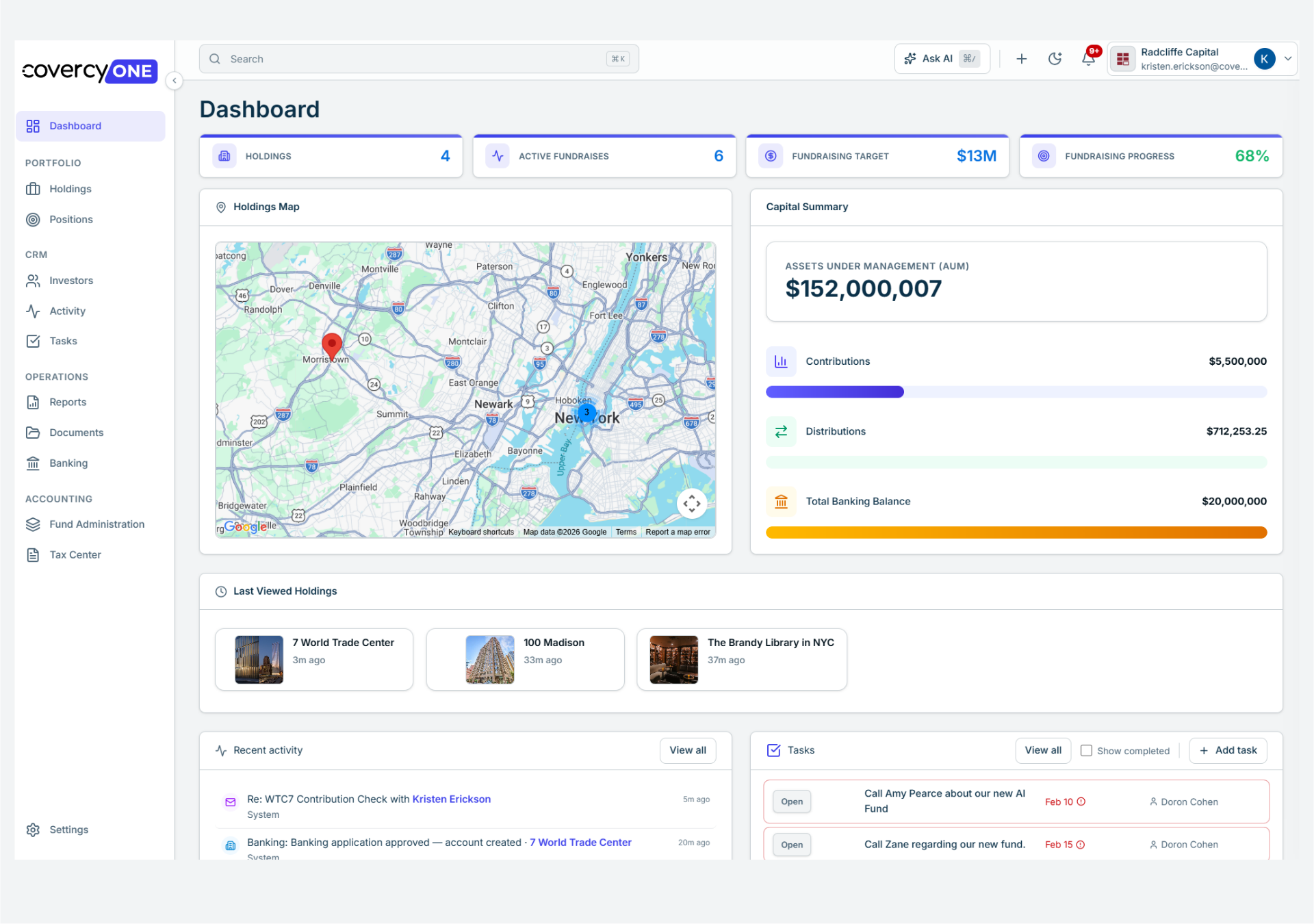
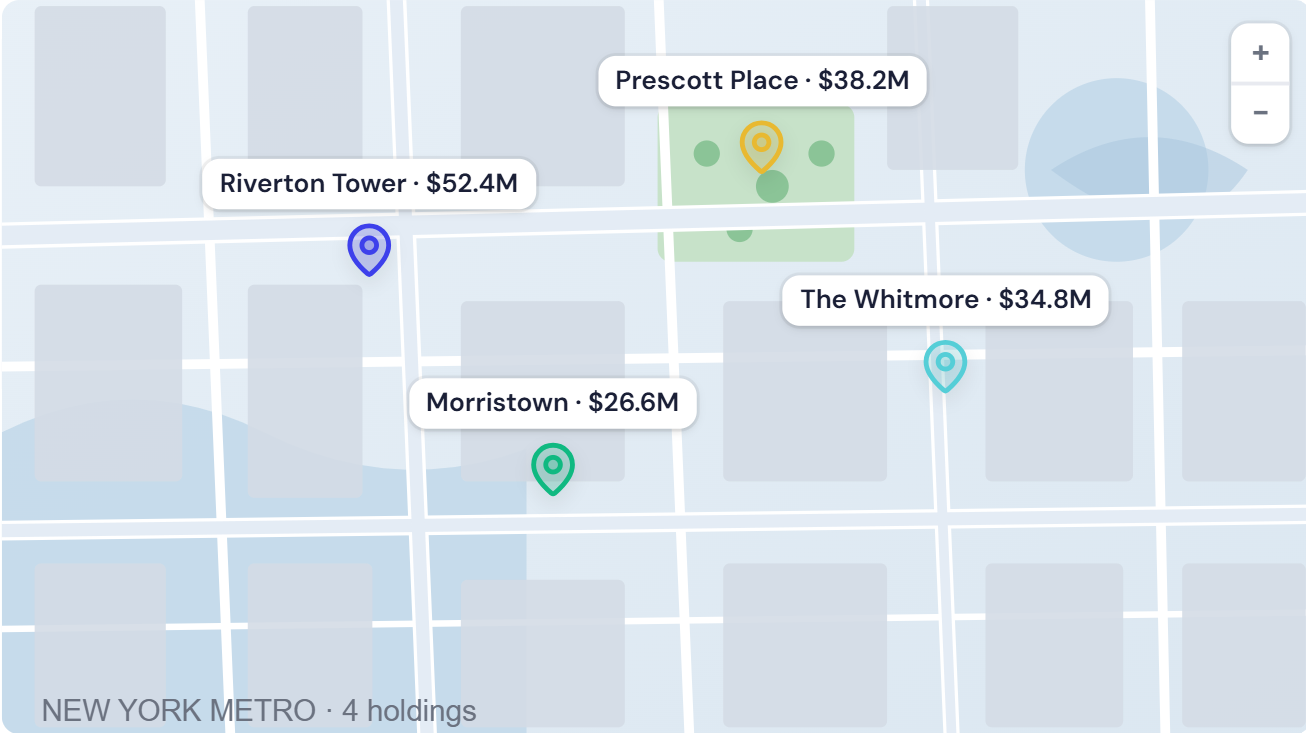






Best for: real estate GPs and syndicators who want a fund administration team and their front office, from fundraising to capital calls and distributions with preferred return and catch-up, on one live ledger, with AI built in and published plans.
Gen II Fund Services
Gen II Fund Services is a fund administrator for private capital. On its home page, Gen II says it has built its business over 17 years and has more than $2 trillion in assets under administration. Its fund administration page invites managers to “outsource your back-office” and lists partnership accounting, waterfall and carried interest calculations, capital call and distribution processing, NAV reporting, K-1 preparation and investor portal access, across private equity, private credit, real assets and fund of funds. Its real assets practice administers real estate equity, real estate debt and infrastructure, including joint ventures, SPVs and club deals, and its Sensr investor portal, which includes AI, is available for licensing by any fund sponsor. Gen II does not publish pricing on the pages we reviewed. Covercy has a separate Gen II alternatives page.
Best for: private capital sponsors, including real estate and infrastructure managers with joint ventures, SPVs and multi-jurisdictional structures, who want a dedicated outsourced team plus investor technology.
Juniper Square
Juniper Square describes itself on its home page as an operations partner for private markets, with more than 2,300 GPs running their funds on its platform. It says fundraising, investor onboarding, fund accounting, treasury, compliance and reporting run on the same source of truth, and that its JunieAI drives a family of AI agents built into those workflows. Its fund administration services cover fund accounting, treasury services for capital calls, distributions and other payments, investor services, onboarding, AML/KYC and management company accounting, for more than $200 billion of assets. Juniper Square says it has strong roots in commercial real estate, serving hundreds of real estate investment firms, and offers Deal Services for syndicators, including outsourced distribution management. It does not publish pricing on the pages we reviewed.
Best for: real estate and other private markets managers, from syndicators to institutional firms, who want an established investor platform, AI agents and a fund administration team from one provider.
How they compare
| Criteria | Carta | AngelList | Covercy | Gen II | Juniper Square |
|---|---|---|---|---|---|
| Service model | Platform plus fund administration | Software-enabled service | Fund administration team plus platform | Outsourced team plus software | Platform plus fund administration |
| Fund types served | Private funds and private companies | Venture funds, SPVs, syndicates | Real estate syndications and funds | PE, credit, real assets, fund of funds | PE, real estate, VC, credit, FoF |
| Cap table and ownership records | Company equity management | Investor management software | Live cap table by share class | JV and SPV administration | Funds, investors and positions connected |
| Investor portal | LP access to calls, documents, tax | LP portal and data room | Native branded investor portal | Sensr Portal | Investor portal |
| Capital calls and distributions | GPs request calls and distributions | Initiated in GP dashboard | Pref and catch-up, paid in-product | Processed by Gen II’s team | Treasury services team |
| Banking and payments | Connected bank accounts, money movement | Wire execution; Nova coming soon | Distributions paid from the platform | Not detailed on cited pages | Treasury services for payments |
| AI | AI-enabled Carta CRM | AngelList Link MCP server | Neo, grounded in the live ledger | AI in the Sensr Portal | JunieAI and AI agents |
| Pricing | Not detailed on cited pages | Published: % of fund plus flat fee | Published plans, 14-day free trial | Not published | Not published |
“Not detailed on cited pages” means the provider’s own pages we reviewed don’t describe it, not that the provider doesn’t offer it. Ask each provider directly. Several options here describe one connected system: AngelList runs formation through reporting on one platform, Juniper Square runs its workflows on the same source of truth, and Alternatives Watch reports that Carta CRM syncs from the Carta Ledger. The rows show where each is focused, not who has a single system.
Questions to ask any provider
- Which fund types and structures do most of your clients run: venture funds, private equity, or real estate deals and funds?
- How do you model real estate waterfalls, including preferred return, catch-up and promote, and who calculates each distribution?
- Are capital calls and distributions paid from the platform, or do we send the payments ourselves?
- Do your fund administration team and our investor portal, capital calls and distributions work from the same records?
- How are ownership records kept: by company cap table, by fund, or by deal, share class and position?
- What AI is built into the platform, and what data does it draw on?
- How is pricing set, and what changes it as we add funds, deals or investors?
- What does onboarding look like, and how do you migrate our historical data from Carta?
- What is Carta used for?
- Carta is used by private companies to manage equity, such as issuing equity, managing stakeholders and 409A valuations, and by private fund managers for fund administration, tax, LP access and, more recently, a CRM that syncs with its fund ledger.
- Does Carta provide fund administration?
- Yes. Carta offers fund administration alongside its platform. Alternatives Watch reported in March 2026 that its fund administration, tax and compliance tools are used by nearly 9,000 funds representing more than $203 billion in assets.
- Who are Carta's main competitors for fund administration?
- Fund managers comparing Carta often look at AngelList for venture funds and syndicates, Juniper Square for a platform plus fund administration across private markets, outsourced administrators such as Gen II Fund Services, and Covercy for real estate GPs who want a fund administration team and their front office on one live ledger.
- Which Carta alternative suits a real estate GP?
- A real estate GP can compare Juniper Square and Covercy, which both pair a platform with a fund administration team and serve real estate firms, and Gen II, whose real assets practice administers real estate equity and debt, joint ventures and SPVs. Covercy is built for real estate GPs and syndicators, with distributions that allocate preferred return and catch-up and are paid from the platform.
- Which Carta alternatives publish their pricing?
- On the pages we reviewed, AngelList publishes venture fund pricing as a percentage of fund size plus an annual flat fee, and Covercy publishes its plans with a 14-day free trial. Carta, Gen II and Juniper Square do not detail pricing on the pages we cite, so expect a quote.
Источники
- Carta, Carta Help Center. Дата обращения: 2026-11-21.
- Carta, Banking & money movement. Дата обращения: 2026-11-21.
- Carta, Fund financials. Дата обращения: 2026-11-21.
- Carta, Limited partners. Дата обращения: 2026-11-21.
- Alternatives Watch, Carta buys AI-powered CRM ListAlpha (Susan Barreto), 2026-03-03. Дата обращения: 2026-11-21.
- AngelList, AngelList home page. Дата обращения: 2026-11-21.
- AngelList, Venture Funds. Дата обращения: 2026-11-21.
- AngelList, Venture Funds Pricing. Дата обращения: 2026-11-21.
- Gen II Fund Services, Gen II Fund Services home page. Дата обращения: 2026-11-21.
- Gen II Fund Services, Private Capital Fund Administration Services. Дата обращения: 2026-11-21.
- Gen II Fund Services, Real Assets Fund Services. Дата обращения: 2026-11-21.
- Gen II Fund Services, Sensr Investor Portal. Дата обращения: 2026-11-21.
- Juniper Square, Juniper Square home page. Дата обращения: 2026-11-21.
- Juniper Square, Fund Administration. Дата обращения: 2026-11-21.
- Juniper Square, Real Estate. Дата обращения: 2026-11-21.