Meet Neo, your AI-powered Co-GP.

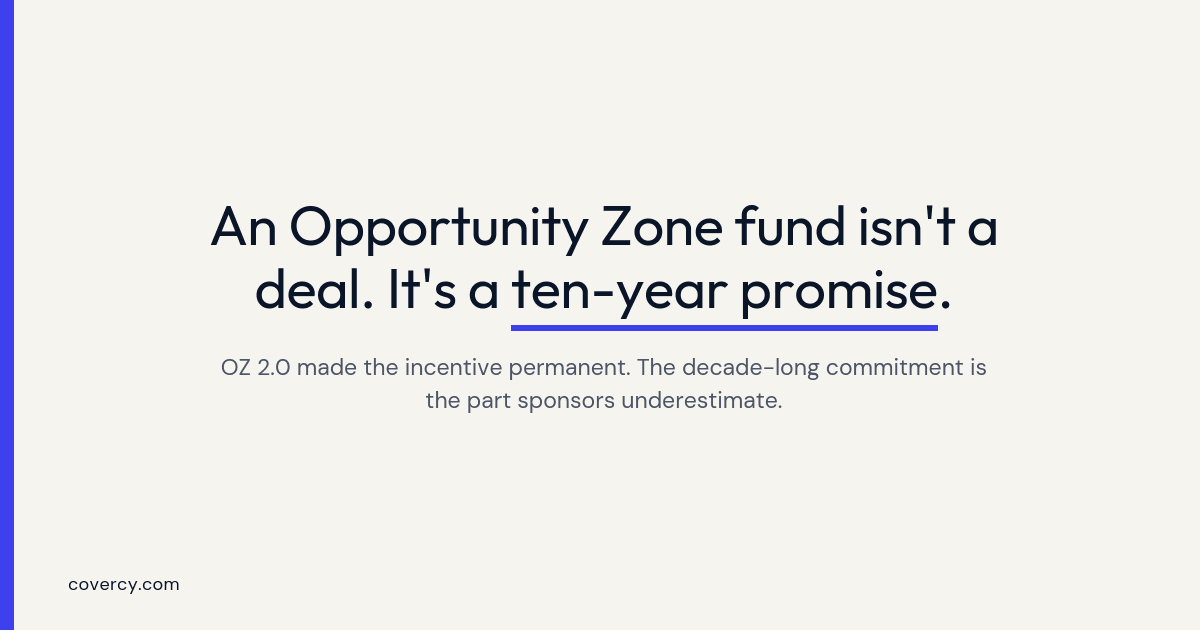
For seven years, the Opportunity Zone program lived under a countdown. The capital-gains incentives created in 2017 were scheduled to wind down, and the zone map itself was set to expire — which made every qualified opportunity fund a race against a closing window. The 2025 federal tax law changed that. The One Big Beautiful Bill Act, signed July 4, 2025, made Opportunity Zones a permanent part of the tax code, replaced the fixed deadlines with a rolling structure, and set a brand-new zone map to take effect January 1, 2027. Governors are nominating the next round of eligible census tracts during 2026 — which means the map that will define the next decade of Opportunity Zone deals is being drawn right now.
That shift matters to two audiences at once: the investor sitting on a capital gain who wants to defer and potentially eliminate tax on it, and the general partner (GP) — the sponsor or fund manager — deciding whether to stand up a qualified opportunity fund (QOF) to raise that capital. This article walks through both sides: how the tax benefit actually works for a limited partner (LP), what the new rural incentive changes, and what running a QOF demands of a sponsor operationally. It is educational only and not tax, legal, or investment advice — the mechanics below are general, the stakes are high, and anyone acting on this should work with qualified tax counsel and securities attorneys.
Note
The figures and dates here reflect the Opportunity Zone provisions of the One Big Beautiful Bill Act as understood in mid-2026. Treasury and the IRS are still issuing guidance, and details can change. Confirm every number with your own tax advisor before relying on it.
What actually changed in 2025
The original Opportunity Zone program was a temporary experiment with a hard stop. The 2025 law turned it into permanent policy and rebuilt the timing around a rolling clock rather than a single expiration date. For sponsors and investors who found the old deadlines nerve-wracking, that is the headline: the incentive is no longer something you have to use before it disappears.
- Opportunity Zones are now permanent, with governors redesignating eligible census tracts on a recurring ten-year cycle rather than a one-time map.
- A new zone map takes effect January 1, 2027, with governors nominating tracts during 2026 — so the eligible geography for deals over the coming decade is being set now.
- For investments made after December 31, 2026, the capital-gains deferral is a rolling five-year window tied to the investment date, not a fixed calendar deadline.
- A new class of rural qualified opportunity funds carries materially stronger benefits than standard funds (more on that below).
- The long-term payoff — eliminating tax on the appreciation of a qualifying investment held for at least ten years — remains the core draw.
There is a transition period as the original 2017 zones give way to the new map, and the interaction between old and new designations carries nuance that depends on when an investment was made. That transition is exactly the kind of detail to confirm with a tax advisor rather than assume — but the strategic takeaway is simple: Opportunity Zones are now a durable planning tool, and the next map is imminent.
How the tax benefit works — for the investor putting in a gain
Start with the investor's perspective, because the sponsor's pitch is built on it. An Opportunity Zone investment is designed for someone who has realized a capital gain — from selling stock, a business, or another property — and wants to do something more efficient than simply paying the tax. Rolling that gain into a qualified opportunity fund within the required window unlocks three distinct benefits that stack over time.
- Deferral: the recognized capital gain rolled into a QOF is deferred. For investments made after December 31, 2026, that deferral runs on a rolling five-year clock — the deferred gain is generally recognized at the end of five years or when the investment is sold, whichever comes first.
- Step-up: after a five-year hold, the investor receives a basis step-up on the deferred gain — 10% for a standard QOF, which reduces the amount of the original gain that eventually gets taxed.
- Exclusion: this is the big one. If the investor holds the QOF investment for at least ten years, they can generally elect to step the basis up to fair market value on sale — excluding all of the post-investment appreciation from federal capital gains tax. (The exclusion is subject to a rolling 30-year cap.)
The ten-year exclusion is what makes Opportunity Zones distinct from a plain deferral play. Deferring a gain for five years is useful; growing a new investment for a decade and paying zero federal tax on that growth is transformative. It also explains the profile of the typical Opportunity Zone LP: patient capital, a long horizon, and a real tax problem to solve. For a sponsor, that is both an opportunity and an obligation — you are asking investors to commit for ten years, and the relationship has to hold up for just as long.
The rural twist: why OZ 2.0 favors rural deals
The most consequential new lever in the 2025 law is a separate, richer benefit for rural investments. The law created a new category — the qualified rural opportunity fund — and weighted the incentives heavily toward it.
- Triple the step-up: a rural QOF investment earns a 30% basis step-up after five years, versus 10% for a standard fund.
- A lower improvement bar: for the substantial-improvement requirement (the rule that you must meaningfully invest in an existing building, not just buy it), the threshold for rural property is cut in half — from doubling the building's basis to increasing it by 50%.
For a GP evaluating where to place a fund, that rural halving of the substantial-improvement test is not a footnote — it can materially change which value-add and development deals pencil out. It is also a signal about where policymakers want this capital to flow. Whether a rural strategy fits a given sponsor's expertise and investor base is a separate question, but the incentive math now clearly rewards it.
What a qualified opportunity fund requires of a sponsor
For the general partner, a QOF is not a passive wrapper — it is an operating obligation with ongoing compliance tests. The tax benefits investors receive depend on the fund actually meeting the program's requirements, year after year, which puts the operational burden squarely on the sponsor. The core obligations include:
- The 90% asset test: a QOF must generally hold at least 90% of its assets in qualified Opportunity Zone property, measured at two points each year. Miss it and the fund can face penalties.
- Substantial improvement and timing: acquired buildings generally have to be substantially improved within 30 months, and capital has to be deployed on schedule to stay qualified.
- A decade of records: because the marquee benefit hinges on a ten-year hold, the fund has to track each investor's entry date, capital account, and holding period accurately for the full life of the investment.
That last point is where many sponsors underestimate the work. Running a fund whose central promise is a precise ten-year holding period means the underlying records — who invested, when, how much, and what their capital account looks like today — have to stay clean and accessible for a very long time. When that data lives across spreadsheets and disconnected vendors, the risk compounds with every year and every new investor. Keeping capital accounts, positions, and holding periods in a single system that the whole team works from is not a nice-to-have for a QOF; it is the difference between a defensible ten-year track record and a reconciliation scramble when investors start asking about their exclusion.
Why the ten-year hold reshapes investor relations
A ten-year commitment changes the nature of the GP–LP relationship. In a typical deal-by-deal syndication, investors cycle in and out over a few years. In a QOF, you are signing up for a decade with the same limited partners — and their expectations for transparency and communication scale accordingly. An investor who has parked a significant gain with you, betting on tax-free appreciation ten years out, will want to see how that investment is doing along the way, not just hear from you at exit.
This is where the investor experience does real work. Giving LPs a professional portal with 24/7 access to their capital accounts, performance, and documents removes the quarterly scramble of chasing statements and answering one-off status emails — and it builds the trust that keeps investors comfortable through a long hold. Tax documents are a recurring flashpoint here: over a ten-year life, every LP needs their K-1 delivered accurately and on time, every single year. Delivering those documents through the same portal where investors already track their holdings turns an annual fire drill into a routine, and signals the kind of institutional-grade operation that patient capital expects.
Raising and administering a QOF
The window matters on the raise, too. With deferral tied to when an investor realizes a gain, timing is often driven by the LP's calendar, not the GP's — which means onboarding has to be fast when an investor is ready to commit. A modern fundraising flow that takes an investor from interested to funded in one sitting — deal materials, accreditation and identity verification, e-signed subscription documents, and funding by ACH — captures capital while the gain is fresh, rather than losing momentum to a paper-and-email process.
Once the fund is live, the administrative reality of a QOF is the same as any other fund, only longer: capital calls if the structure uses them, distributions during the hold, reconciliations, and reporting — all of which have to stay accurate across a ten-year life. Handling those money movements and the fund's banking in the same platform that holds the investor and capital-account data keeps the operational side from fragmenting as the fund ages. The goal isn't more software; it's fewer seams — one source of truth for the data the fund's tax benefits ultimately depend on.
Covercy One brings fundraising, banking, distributions, and investor reporting into one platform — so the capital accounts, holding periods, and K-1 delivery a long-hold fund depends on stay accurate and accessible for the full decade.
See how it works (opens in a new tab)Before you launch — or invest: questions for your advisors
Opportunity Zone rules sit at the intersection of tax law, securities law, and real estate — and the 2025 changes are still being interpreted through Treasury and IRS guidance. This article is a starting point for understanding the landscape, not a substitute for professional advice. Before committing capital or standing up a fund, work through questions like these with qualified counsel:
- For investors: Does my gain qualify, and what is my exact deadline to invest it? How do the deferral, step-up, and ten-year exclusion apply to my specific situation and state tax exposure?
- For sponsors: How should the fund be structured to meet the 90% asset test and substantial-improvement rules — and is a rural strategy a fit? What securities-law obligations apply to how I raise and market the fund?
- For both: How does the 2027 zone map and the transition from the original zones affect the specific property or fund under consideration?
- What is a qualified opportunity fund (QOF)?
- A qualified opportunity fund is an investment vehicle organized to invest in property located in a designated Opportunity Zone. Investors roll realized capital gains into the fund to defer — and, with a long enough hold, potentially eliminate — federal capital gains tax. The fund must generally keep at least 90% of its assets in qualifying Opportunity Zone property.
- What did the 2025 tax law (OZ 2.0) change about Opportunity Zones?
- The One Big Beautiful Bill Act, signed July 4, 2025, made Opportunity Zones permanent with a recurring ten-year redesignation cycle, moved to a rolling five-year gain-deferral window for investments after December 31, 2026, and created a new rural qualified opportunity fund category with a 30% basis step-up (triple the standard 10%) and a halved substantial-improvement test. A new zone map takes effect January 1, 2027.
- What is the tax benefit of holding a QOF investment for ten years?
- An investor who holds a qualifying QOF investment for at least ten years can generally elect to step the investment's basis up to fair market value on sale, excluding all post-investment appreciation from federal capital gains tax (subject to a rolling 30-year cap). This ten-year exclusion is the program's central incentive.
- What are the main compliance obligations for a QOF sponsor?
- A sponsor must generally satisfy the 90% asset test (measured twice a year), meet substantial-improvement requirements and deployment timelines, and maintain accurate per-investor records — entry dates, capital accounts, and holding periods — for the full ten-year life of each investment, since the investor's tax benefit depends on it.
Opportunity Zones just went from a fading incentive to permanent policy, with a fresh map about to open a new decade of deals. For sponsors, the opportunity is real — and so is the ten-year operational commitment that comes with it. Building on infrastructure that keeps investor data, capital accounts, and reporting accurate for the long haul is how that commitment stays a strength rather than a liability.