Commercial Real Estate Investment Strategies: Undervalued Asset Classes to Watch in 2026 | Covercy
Asset Classes·11 min read
Commercial Real Estate Investment Strategies: Undervalued Asset Classes to Watch in 2026
A framework-driven look at commercial real estate investment strategies for 2026, the undervalued property types the smart money overlooks, why they stay cheap, and how to tell a real opportunity from a value trap.
Kristen Erickson··11 min read
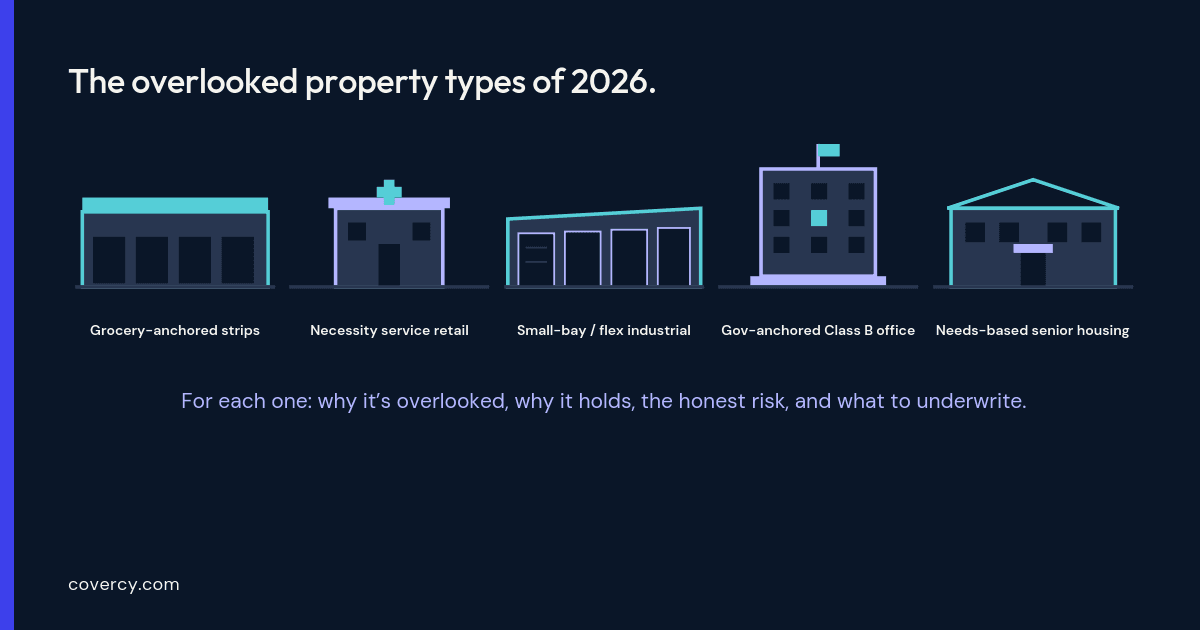
Most commercial real estate investment strategies chase the same handful of institutional-grade assets, which is exactly why they get expensive. The more interesting question for a general partner (GP) writing checks in 2026 is the opposite one: which property types does the smart money keep skipping, and are any of them skipped for a reason you can actually exploit?
This is not a list of secret deals. It is a framework for thinking about why whole sectors stay cheap, followed by five overlooked property types where that logic is playing out right now. Some were genuinely overlooked and are only now proving out. One is cheap for reasons you should respect. Knowing which is which is the entire edge.
Why capital overlooks whole sectors
Sectors do not get overlooked at random. Capital avoids them for a small, repeatable set of reasons, and each reason is also a filter you can turn to your advantage. When you can name why a sector is cheap, you can underwrite whether the discount is a gift or a trap.
Across the property types below, five repellents do almost all the work:
Too small for institutions. Deals that fall below a fund's minimum check size get a thin bid, and a thin bid shows up in the price.
Operationally intensive. Assets that depend on a skilled operator scare off passive capital that just wants to clip a coupon.
Off the institutional map. Tertiary and secondary markets get fewer eyeballs, which means less competition and more off-market flow.
Financing or regulatory friction. Sectors that are hard to lend on or hard to permit stay structurally cheap, sometimes correctly.
Priced below replacement cost. When you can buy built-out space for less than it would cost to rebuild today, the improvements come nearly free.
Related Articles
Hold those five in mind as you read. Every property type that follows is really just one of these repellents in disguise, and the job is to decide whether the market is mispricing the risk or pricing it exactly right. For where each of these sits in the wider menu, our overview of commercial real estate asset classes is the companion piece to this one.
Grocery-anchored strip centers
For a decade, "retail" was a dirty word in institutional portfolios, tarred by mall bankruptcies and the e-commerce story. That blanket aversion is the repellent here, an entire category written off by association, and it left grocery-anchored strip centers trading well behind their fundamentals. The gap is now closing fast, which is the tell that the sector was undervalued rather than broken.
The 2026 data is blunt about it. U.S. grocery-anchored transaction volume reached roughly $11 billion in 2025, up about 42% year over year, and the institutional share of buyers hit its highest level in more than a decade, according to CommercialSearch. Phillips Edison & Company, one of the largest grocery-anchored owners, has reported portfolio occupancy above 97%. In one industry survey, 85% of institutional retail investors named grocery-anchored centers their top retail preference, the highest of any format.
What holds the asset up is boring and durable: a grocer drives weekly, needs-based foot traffic that no website replaces, and the inline tenants around it feed off that traffic. The honest risk is that the easy discount is already gone at the institutional end, where cap rates for the best centers have compressed into the mid-5s. The room left is at the smaller, single-center scale in secondary markets, where deals are still too small for the big funds. Underwrite the grocer's sales per square foot and lease term, not the logo.
Necessity service retail
The sibling to grocery-anchored is even more overlooked because it is unglamorous by design: the dentist, the urgent-care clinic, the physical-therapy studio, the nail salon, the vet. This is service retail, and it caught the same reflexive e-commerce fear as the rest of the category, even though almost none of it can be delivered by a website.
The leasing data has quietly flipped in its favor. In 2025, just over half of all retail square footage leased went to service-oriented businesses, and the "medtail" wave, dental, physical therapy, and urgent care signing long-term leases in retail plazas, is a durable driver, per the National Law Review and First National Realty Partners. Retail vacancy has tightened to multi-decade lows in many metros, and total retail transaction volume reached roughly $60 billion in 2025, up about 27% year over year.
Medical and service tenants sign longer leases and face virtually no e-commerce competition, which is the whole appeal. The honest risk is tenant-level: a single-location operator can fail, so the credit and the site matter more than the brand on the door. Underwrite the trade area and the tenant's business, not a national logo. For where consumer behavior is pushing these centers, see our read on Gen Z and retail commercial real estate trends.
Small-bay and flex industrial
Big-box logistics is thoroughly discovered. The overlooked corner of the same sector is the small stuff: small-bay flex industrial and industrial outdoor storage (IOS), the truck yards, equipment lots, and contractor storage that keep a supply chain physically running. The repellents here are two of our five at once, individual sites are too small for institutional check sizes, and the use is hard to permit, because no city planner dreams of more gravel lots.
Those same frictions are why the numbers are strong. Institutional investors committed more than $900 million to IOS in 2025, per Bisnow, and sector rents have climbed roughly 123% since 2020 against sub-3% vacancy. Supply is capped by zoning and a shortage of appropriately entitled land, so existing sites enjoy a moat that is hard to replicate. The tenant base has broadened well beyond trucking into construction, utilities, and renewable-energy operators, per CRE Daily.
The catch is fragmentation, which is also the opportunity for a GP willing to aggregate. Buying and stitching together a portfolio of small, unglamorous parcels is operationally heavier than closing one shiny warehouse, and that drag is precisely what keeps larger, more passive capital at arm's length. For the broader thesis, see our take on what's driving interest in industrial commercial real estate.
Government-anchored Class B office
Office is the most feared word in commercial real estate right now, and that fear is the repellent. Buried inside the wreckage is a narrower asset that looks different: Class B office anchored by a government tenant, a courthouse annex, a state agency, a Social Security office, a public-health clinic. These tenants do not chase trophy towers, they rarely relocate, and their leases are long. That is why government-leased real estate has historically been treated as a bond substitute.
But 2026 is exactly the wrong year to buy that reputation uncritically, and this is where honesty matters most. Federal lease stability is being tested: the General Services Administration exercised early terminations on nearly 9 million square feet of office space in 2025, and roughly 52% of federal leases either expire or can be terminated through 2028, per GlobeSt and Federal News Network. Weak Class B demand in secondary markets is the most exposed corner of that shift.
So the edge is narrow and specific, not "buy government office." It is mission-critical state and local tenants, courthouses, and health or education uses that cannot be consolidated away, bought at a basis that already prices in the risk, or acquired cheaply enough to reposition. Underwrite the specific tenant's essentiality and the replacement-cost basis, and treat federal GSA exposure as a risk to be paid for, not a guarantee. The repositioning path is real, as we cover in office conversions.
Needs-based senior housing
Senior housing is overlooked for the second repellent on the list: it is genuinely operator-dependent. This is a business you run, not a lease you collect, and that scares off capital that wants real estate to behave like a bond. But the demographic wave behind it is about as close to a sure thing as this industry offers.
The supply-demand gap is now stark. The National Investment Center for Seniors Housing & Care (NIC) reported senior housing occupancy climbing to 89.5% in early 2026, on track to pass 90% before year-end, while 2025 inventory growth came in at just 1%, the lowest since NIC began tracking the data in 2006. Units under construction fell to roughly 2.3% of existing stock, near a multi-decade low. Demand keeps rising as the Baby Boomers age in; new supply simply is not being built to meet it.
The edge is in needs-based senior housing, assisted living and memory care, where the resident moves in because they have to, not because they want a lifestyle upgrade, in secondary markets the big operators overlook. Underwrite the operator first and the building second. The healthcare-adjacent thesis runs parallel to what we cover in the newest healthcare real estate opportunities and our look at medical outpatient buildings.
The principle beneath all five: below replacement cost
One idea cuts across every property type above, and it is the single sharpest filter on this page: wherever you can buy built-out, second-generation space for less than it would cost to build it new, the improvements come nearly free. When construction and fit-out costs sit far above acquisition prices, as they do across much of the market in 2026, a functional building with existing infrastructure is worth more than its price tag suggests.
This is why a second-generation service-retail box with working plumbing and power, an older flex-industrial building, or a repositionable government office can pencil when a ground-up build cannot. Underwrite the replacement-cost gap explicitly on any of these: what would it cost to rebuild this today, and how far below that number can you buy?
Which is the most profitable commercial real estate strategy?
Investors searching for the most profitable commercial real estate almost always want a single answer, and the framework above explains why there isn't one. Profit in overlooked sectors is a function of the repellent you are willing to take on, not the property type on the sign. The highest returns tend to sit where the operational lift or the small-deal fragmentation is heaviest, IOS aggregation, needs-based senior housing, service-retail portfolios, because that difficulty is exactly what thins the competition and holds the price down.
Put plainly: the most profitable commercial real estate for a given GP is the sector whose specific repellent matches that GP's actual capability. A team that can operate will make more in senior housing than a passive allocator ever could; a team that can aggregate and manage many small parcels will out-earn a fund that only writes large checks. Match the strategy to your edge, and the return follows.
The traps: overlooked for good reason, or already discovered
Not every discount is a gift, and an honest strategy names the traps too. Some sectors are cheap because the fourth repellent, financing and regulatory friction, is a permanent tax rather than a temporary mispricing. Cannabis-adjacent real estate is the clearest example: tenant demand is real, but banking constraints, single-purpose buildouts, and shifting regulation mean the discount is compensation for genuine, structural risk. That is a sector to approach with eyes open, not a bargain to chase.
Distress is its own category, a timing play rather than a durable property type. Oversupplied Sun Belt multifamily is the live example: values are down roughly 10% from peak and more than 5,100 multifamily properties in the securitized market now carry a debt-service-coverage ratio below 1.0, per CRE Daily, concentrated in overbuilt metros. That can be a real entry point, but it is a dislocation to time, not a sector to hold forever. We cover the timing in is the Sun Belt multifamily boom already over and the mechanics in navigating distressed commercial real estate.
The mirror-image mistake is chasing a discount that has already been arbitraged away. Self-storage and manufactured-housing communities were the overlooked darlings of the last cycle; institutional capital has since compressed the very edge that made them interesting. They are still fine businesses, covered in revisiting self-storage and managing manufactured home investing, but they are no longer secrets, and underwriting them as if they were is how you overpay.
The operational catch, and how to manage it
Notice the thread running through every genuinely undervalued property type here: they are overlooked precisely because they are operationally messy. Many small tenants. Multiple secondary markets. Hands-on management. Scattered, sub-institutional deals that never add up to one clean line item. The discount and the difficulty are the same fact viewed from two sides.
That is also the practical reason these strategies stay out of reach for a lot of GPs, running a portfolio of unglamorous assets across markets is an administrative burden. Covercy One is built for exactly that burden: it brings investor management, embedded banking, capital calls, and automated distributions into one platform, so a limited partner (LP) base spread across many small deals is manageable rather than punishing. When the back office is handled, you are free to underwrite the messy sectors everyone else avoids.
Frequently asked questions
Which commercial real estate sectors are undervalued or overlooked in 2026?
Five overlooked property types stand out in 2026: grocery-anchored strip centers, necessity service retail (including medtail), small-bay and flex industrial with industrial outdoor storage (IOS), government-anchored Class B office, and needs-based senior housing. Each is overlooked for a specific, nameable reason, too small for institutions, operationally intensive, off the institutional map, or hard to finance, rather than because the fundamentals are weak. Distress in oversupplied Sun Belt multifamily is a related timing play rather than a durable type.
What is the most profitable commercial real estate to invest in right now?
There is no single most profitable commercial real estate sector; profitability tracks the difficulty you can absorb. The highest returns tend to come from sectors with heavy operational or small-deal complexity, IOS aggregation, needs-based senior housing, and service-retail portfolios, because that difficulty limits competition and keeps entry prices low. The most profitable choice for any given GP is the sector whose specific challenge matches that team's real capability.
Is government-anchored office actually safe to buy in 2026?
Only selectively. Government tenants are sticky and rarely relocate, but federal lease stability is under pressure: the GSA terminated nearly 9 million square feet of office leases in 2025, and about 52% of federal leases expire or can be terminated through 2028, hitting Class B secondary markets hardest. The defensible edge is mission-critical state, local, courthouse, or health and education tenants bought at a basis that already prices the risk, not blanket federal office exposure.
How do I know if an overlooked sector is a genuine opportunity or a value trap?
Name the reason it is cheap. If the discount comes from a temporary condition, a thin institutional bid, a market off the radar, or a supply glut that is already correcting, it may be a real opportunity. If it comes from a permanent structural problem, such as the financing and regulatory friction around cannabis-adjacent real estate, the low price is compensation for genuine risk, not a bargain.
 Meet Neo, your AI-powered Co-GP.