Meet Neo, your AI-powered Co-GP.

Most real estate GPs raise capital the same way: calls to existing investors, warm introductions from brokers, and the occasional conference. That network is valuable, but it has a ceiling. Rule 506(c) of Regulation D removes that ceiling. It lets you advertise an offering to the public — paid search, LinkedIn, Facebook, retargeting — as long as every investor who ultimately commits is verified as accredited. For sponsors who want to grow beyond their existing network, 506(c) is one of the most underused tools in the capital-raising playbook.
This article is for GPs and fund managers who want to understand what 506(c) actually allows, how it differs from the more common 506(b) exemption, and how to build a paid-advertising strategy that converts qualified prospects into committed investors. It is educational in nature and does not constitute legal, investment, or securities advice. GPs considering a 506(c) offering should work with qualified securities counsel before launching any campaign.
What Is Rule 506(c)?
Rule 506(c) is an exemption under Regulation D of the Securities Act of 1933. It allows issuers — including real estate GPs raising capital for syndications and funds — to conduct a "general solicitation," meaning they can advertise and publicly market an offering without registering it with the SEC. Prior to the JOBS Act of 2012, which created 506(c), all Reg D offerings had to be conducted privately. You could only approach investors you had a pre-existing substantive relationship with. The JOBS Act changed that, and 506(c) became effective in 2013.
The trade-off for getting to advertise publicly is that every investor who participates must be verified as accredited. Under 506(c), self-certification — the investor checking a box confirming their accredited status — is not enough. You must take "reasonable steps" to verify accreditation independently. What counts as reasonable steps is defined by Rule 506(c)(2)(ii) and depends on the method used, which we cover in detail below.
506(b) vs. 506(c): The Key Differences
The vast majority of private real estate offerings are conducted under Rule 506(b), not 506(c). Understanding the differences helps you decide which exemption fits your situation.
Under 506(b), general solicitation is prohibited — you can only approach investors with whom you have a pre-existing, substantive relationship. The upside is that the verification requirement is lighter: you can accept self-certification from accredited investors, and you can include up to 35 non-accredited but "sophisticated" investors in the offering. Most GPs prefer 506(b) because their investor base is already a known network and the compliance overhead is lower.
Under 506(c), you gain the right to advertise and solicit publicly. The limitation is that all investors — every one of them — must be independently verified as accredited. No non-accredited investors are permitted, regardless of sophistication. That verification requirement adds friction to onboarding, but it also opens your addressable audience to anyone who might see your ad.
One important practical note: a GP cannot mix solicitation methods. If you publicly advertise an offering, it must be conducted under 506(c). Once you have engaged in general solicitation for a particular offering, you cannot fall back to 506(b) for that same raise. Structuring the offering correctly from the start — with guidance from securities counsel — matters.
Why Paid Advertising Works Under 506(c)
The practical implication of 506(c) is that paid digital advertising — the same channels every direct-to-consumer company uses — is now available to real estate GPs. Google Ads, LinkedIn Sponsored Content, Meta campaigns, and retargeting are all permissible methods for reaching prospective investors, as long as the offering complies with 506(c) requirements. This is a meaningful change. Investor acquisition now has a measurable cost-per-lead, a trackable conversion funnel, and a channel that scales with budget rather than personal bandwidth.
There are real advantages to running paid search specifically. Investors actively searching for terms like "real estate private placement," "accredited investor opportunities," or "506(c) offering" have already indicated intent. They are not cold prospects — they are mid-funnel buyers. Capturing them at that moment, rather than waiting for a warm introduction, is exactly the kind of demand paid search can address that relationship-based fundraising cannot.
Building Your Paid-Ads Playbook
A paid-ads strategy for a 506(c) raise is not meaningfully different from any other B2C direct-response campaign — the mechanics of bidding, targeting, creative, and landing pages are the same. What is different is the compliance context. Ad copy and landing pages must not make materially misleading claims, cannot promise returns, and must align with the actual offering documents. Your securities counsel should review ad creative before it runs.
On paid search, bid on intent-driven terms that match your offering type — multifamily syndication, commercial real estate fund, passive real estate investing, and similar. The search volume for these terms is modest, but the intent is high. Negative keywords matter here too: filtering out terms associated with REITs, crowdfunding platforms, or publicly traded securities helps ensure your budget reaches investors who understand private placements.
On LinkedIn, the targeting capabilities are uniquely suited to accredited investor outreach. You can target by job title (executives, founders, managing directors), company size (filtering for high-earning professionals), industry, and seniority level. Sponsored content that leads with the GP's track record, asset type, and projected structure tends to outperform pure lead-gen creative in this channel. LinkedIn InMail is also effective for direct outreach to high-net-worth professionals, though it requires the same compliance discipline as any other solicitation.
Retargeting — showing ads to people who have already visited your investor landing page — is one of the highest-ROI paid channels for private placements. The audience is self-selected and already familiar with your firm. Retargeting sequences that move from awareness creative to deal-specific content to a direct invitation to apply tend to convert well.
Your landing page is where the campaign either works or does not. A 506(c) investor landing page typically presents the offering at a high level, captures the prospect's email and basic contact information, and then moves them into an application or qualification flow. The page should not include detailed offering terms — those belong in the PPM and subscription documents — but it should be compelling enough that a qualified investor wants to learn more.
The Catch: Verifying Accredited Investor Status
The biggest operational challenge in running a 506(c) offering is the verification requirement. Under Rule 506(c)(2)(ii), the SEC has defined four "safe harbor" methods that constitute reasonable steps to verify accreditation. Using one of these methods provides a clear legal path:
The first method is income verification — reviewing IRS forms showing income exceeding $200,000 ($300,000 with a spouse) for the two most recent years, plus a written representation of expected income in the current year. The second is net worth verification — reviewing documentation of assets and liabilities, such as bank statements, brokerage statements, and a consumer report from a credit reporting agency. The third is a written confirmation from a registered broker-dealer, investment adviser, attorney, or CPA that the person is accredited. The fourth is a reliance safe harbor for investors who have previously invested in a 506(c) offering by the same issuer and self-certify their continued accreditation.
In practice, most 506(c) GPs use a third-party verification service or rely on a written confirmation letter from a qualified professional. Requiring investors to upload sensitive financial documents directly creates friction and compliance risk. Third-party services that specialize in accredited investor verification handle the document review and provide the GP with a confirming letter, simplifying the process considerably.
What you cannot do under 506(c) is simply ask investors to check a box certifying their accredited status. That approach is permissible under 506(b) — it is not permissible under 506(c). If your marketing reaches the public, your verification must meet the higher standard.
Attribution and Measurement
One of the structural advantages of digital advertising over relationship-based fundraising is that every touchpoint is measurable. You can track exactly which ad, keyword, or audience segment produced a qualified lead — and ultimately a committed investor. For GPs used to raising from a personal network, this kind of attribution is new. For those who lean into it, it creates a feedback loop that relationship-based fundraising cannot match.
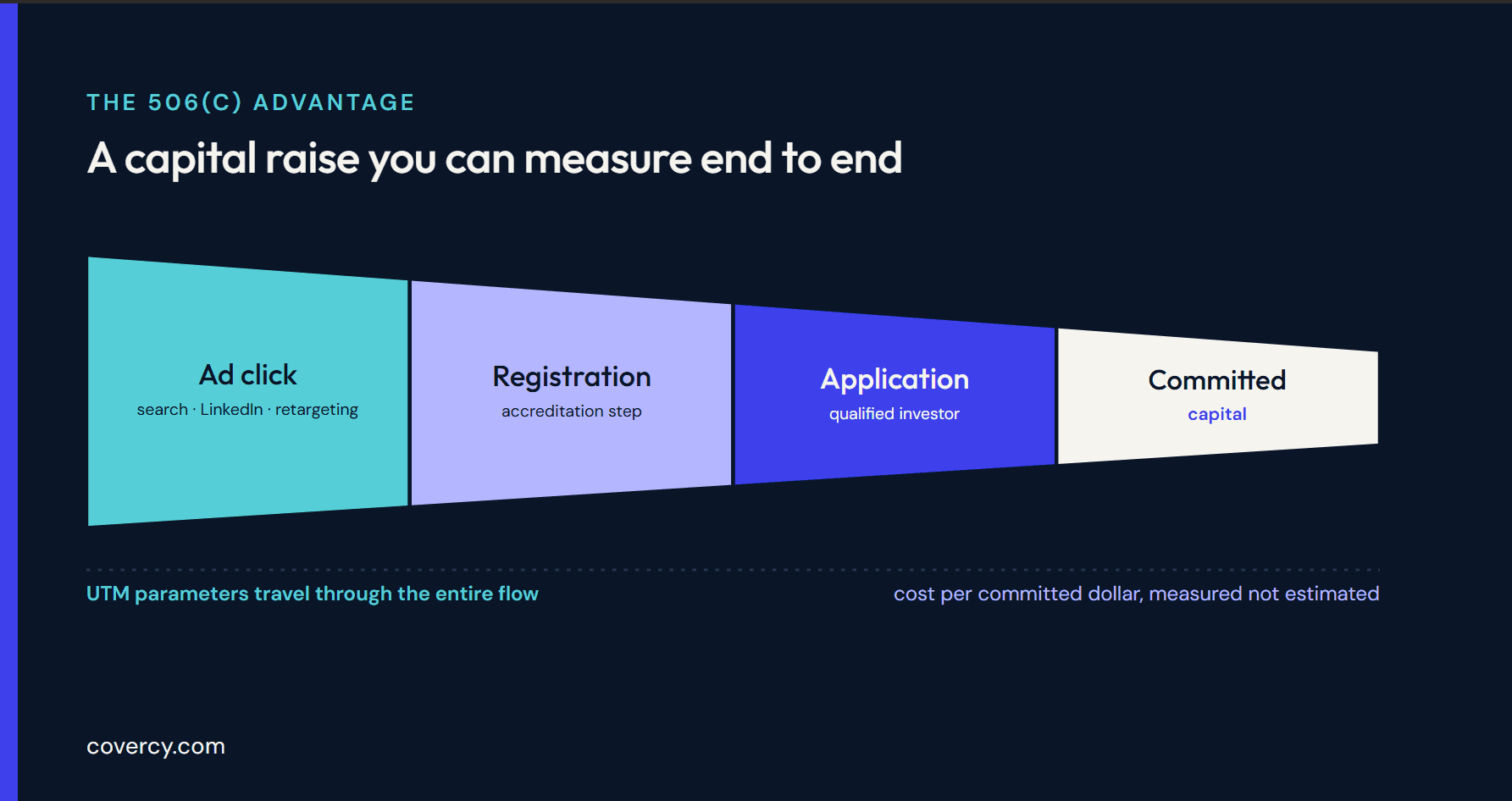
The standard tool for campaign attribution is UTM parameters — URL tags that identify the source, medium, campaign, and specific ad that drove a click. When a prospective investor clicks your ad and lands on your investor portal or application flow, the UTM parameters travel with them through the session. If they convert — meaning they complete an application or make a commitment — you can tie that conversion back to the originating ad campaign.
The metrics to watch are cost-per-qualified-lead (after the initial accreditation screen), cost-per-application, and ultimately cost-per-committed-dollar. Most GPs find that the first two metrics are easy to track and optimize, while the third requires connecting your ad platform data to your investor management system — something we address in the next section.
How Covercy One Supports the 506(c) Workflow
Running a 506(c) campaign without the right back-end infrastructure creates friction at the exact moment you most need a smooth investor experience. Prospects who click your ad, arrive at your portal, and encounter a clunky application process — or have their accreditation handled manually by email — will drop off. Covercy One is designed to close that gap between paid-ad traffic and committed capital.
The accreditation gate in Covercy One lets GPs require investors to self-certify their accredited status before they can access deal information on your investor landing page. For 506(c) offerings, this creates a clean audit trail of which investors completed the accreditation step prior to accessing offering details. GPs can also configure a non-accredited investor limit — up to the SEC-permitted threshold — with over-limit non-accredited investors held for individual GP review and approval. This gives you a single interface to manage the verification workflow rather than handling it through disconnected email threads.
Attribution tracking is built into the platform's investor CRM. Each contact can be tagged with a referral source, and when investors arrive through a tracked link — including from paid campaigns — their source is captured in the contact record. This connects your ad spend to specific investors in your pipeline, giving you the data to evaluate which channels are actually producing committed capital rather than just clicks.
For UTM-specific tracking, Covercy One's investor portal preserves UTM and referral parameters through the login redirect and investment flow. When an investor clicks a paid ad that carries UTM parameters and completes an application, those parameters are forwarded through the full flow and captured in the system. The result is an end-to-end attribution chain: ad click → investor registration → application → commitment, all tied to the originating campaign. This is the data infrastructure that makes cost-per-invested-dollar measurable rather than estimated.
The fundraising pipeline in Covercy One handles bulk investor invitations, pipeline tracking from soft-circle to committed capital, and the opportunity workflow that moves investors from interested to funded. For GPs running 506(c) campaigns at scale — where a single campaign might generate dozens or hundreds of qualified leads — bulk invitation and pipeline management features replace the manual outreach that works at small volume but breaks down as the funnel grows.
Running a 506(c) offering adds compliance overhead, but it opens a fundraising channel that relationship-based approaches cannot match. The combination of intent-driven paid search, LinkedIn audience targeting, UTM-tracked attribution, and a back-end investor management system that connects ad spend to committed capital is what makes 506(c) a practical tool for GPs looking to grow beyond their existing network — not just a legal technicality.
See how Covercy One's accreditation gate, investor CRM, and UTM-preserving portal help GPs run compliant 506(c) campaigns and track every investor back to the source.
Request a demo (opens in a new tab)