
Distribution payments made easy
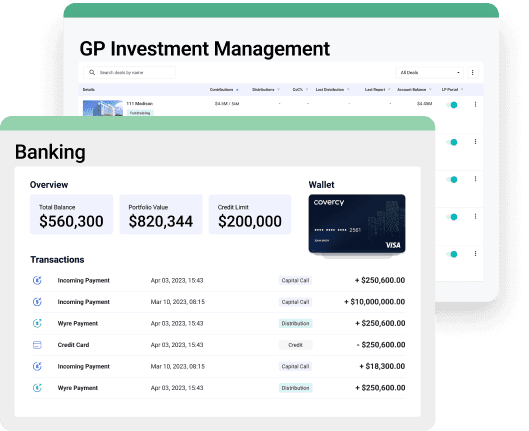
Distribute payments directly to your investors' accounts – all within a single platform – only with Covercy.
Covercy is trusted by:





Everything you need to know about distribution payments
Distribution Payments 101
When it comes to making distribution payments, most GPs care most about keeping investors happy. Covercy built distribution payment features with that end goal in the forefront. Covercy's payment tools empower GPs to connect and fortify LP relationships each time a distribution is made. With Covercy, that means three things: speed, reliability, and convenience.
Speed: Investors want to receive their payments as quickly as possible. Delayed or late payments can be frustrating and can cause investors to lose faith in the investment or the investment manager. Covercy's end-to-end tool integrates bank accounts, which means distribution payments happen instantly. No more waiting for a paper check to arrive in the mail, a wire to go through, or an EFT to clear.
Reliability: Investors want to be sure that their payments will arrive on time and in the correct amount. They want to be able to trust the investment manager to handle their funds responsibly and professionally. With manual processes and calculations done on spreadsheets, the likelihood of errors is high. Covercy's automation features ensure that human error is removed from the process entirely, giving both GPs and LPs peace of mind that payments are correct to the cent.
Convenience: Investors want to be able to access their payments easily and conveniently. They want to be able to choose their preferred payment method and have the flexibility to change it if necessary. Additionally, investors appreciate platforms that offer integrated payment solutions, which allow them to receive their distributions without having to leave the platform.
Investors also value transparency and communication from their investment managers regarding payment distribution. They want to be informed of the payment schedule and any changes in payment amounts or methods. By providing clear and timely communication, investment managers can build trust and foster positive relationships with their investors.

Distribution Payments: A Brief History
The history of distribution payments to investors dates back to the early days of securities markets in the 19th century. During this time, dividend payments were typically made by issuing paper checks that were sent by mail to shareholders. The process was slow, expensive, and cumbersome.
Over time, the process of distributing payments to investors has evolved significantly, largely driven by advances in technology. In the 1970s, electronic funds transfer (EFT) became available, which enabled payments to be made more quickly and securely. However, it wasn't until the 1990s that ACH (Automated Clearing House) payments became widely used for distributing funds to investors.
Today, ACH payments have become the standard for distributing payments to investors because they are faster, more efficient, and more secure than traditional paper checks. ACH payments can be initiated and processed electronically, which eliminates the need for physical checks to be printed, signed, and mailed. This not only speeds up the payment process but also reduces costs and errors.
Moreover, the rise of online investment platforms has made it easier than ever to distribute payments to investors. Many platforms now offer integrated payment solutions that enable investors to receive their distributions directly into their bank accounts without ever leaving the platform. This has made the process even more streamlined and convenient for investors.
Distribution Payments the Covercy Way
With Covercy, GPs can streamline the complex process of managing distribution payments to investors, saving time, reducing errors, and providing investors with greater transparency and insight into the performance of their investments. Covercy can help manage even the most complex waterfall distribution payments to investors in several ways. Here are a few examples:
Distribution Payments in Real Estate
The nuances of making distribution payments to real estate investors can vary considerably compared to other types of investments, such as private equity or funds. Here are some key points of consideration:
Type of Investment
In real estate, the form of investment can range from rental properties, commercial properties, real estate investment trusts (REITs), etc. Private equity involves investments in private companies, while funds might include mutual funds, hedge funds, or exchange-traded funds (ETFs). The mode of distribution payments would vary based on the type of investment.
Frequency of Payments
Real estate investments, particularly rental properties, can provide consistent cash flow in the form of monthly rent payments, which can then be distributed to investors. On the other hand, private equity and fund investments usually distribute returns after a longer period, often after a successful exit event such as a sale or IPO.
Profit Distribution
Real estate profits are typically distributed as a percentage of rental income or property sales. In contrast, private equity or fund distributions can involve complex calculations involving carried interest, management fees, hurdle rates, and high watermark provisions.
Taxation
The tax treatment of distribution payments can vary widely. Real estate investors may have access to tax benefits such as depreciation or 1031 exchanges, whereas private equity investors may be subject to capital gains tax on their returns. The tax implications of funds vary based on the structure of the fund and the type of income it generates.
Liquidity
Real estate is generally less liquid than private equity or fund investments, which may affect the timing and size of distribution payments. While real estate often involves longer holding periods, private equity or fund investments may allow for more flexibility in terms of when and how returns are distributed.
Risk Profile
Real estate is generally seen as less risky compared to private equity or certain funds, but the risk profile of the investment will impact the expected return and consequently the distribution payments to investors.
Distribution Payments Software
Software exists for both investment management and distribution payments, and some companies have successfully brought these feature sets together so they work as one.
Software features typically include ways to simplify the process of calculating and distributing profits to investors. It helps save time and reduce errors compared to manual processes and is particularly useful for real estate companies that have a large number of investors or properties to manage.
Investor Management
Maintain a database of investors, their contact information, their share in various properties, their preferred method of payment, and other relevant details.
Distribution Calculation
Automatically calculate distribution payments based on the parameters set by the user. These might include rental income, capital gains, expenses, and the specific structure of the investment (e.g., preferred returns).
Payment Automation
Automatically distribute payments to investors via their preferred method of payment (e.g., check, bank transfer, PayPal).
Reporting
Generate reports for investors showing the details of their distribution payments, including how the payments were calculated. It may also provide reports for management, showing the overall performance of the properties.
Tax Compliance
Prepare tax documents related to distribution payments, such as 1099 forms in the United States.
Communication
Send notifications to investors when distribution payments have been made, when new reports are available, or when other important events occur.
Integration
The software might integrate with other systems, such as accounting software, property management software, bank accounts, and more. This can save time by reducing the need for manual data entry.
Covercy offers several investment management software packages designed to scale and grow with you, including a forever-free version for up to three assets.
Covercy gives GPs and LPs a number of distribution payment advantages over other software solutions. With Covercy, GPs can calculate, execute and pay distributions with a few simple clicks.
Covercy users have access to powerful waterfall distribution models, which are completely customizable for each individual business case, and unlike most software solutions on the market, Covercy actually transfers funds from the GP or asset account to the LP account. Payments are available instantly and immediately reconciled with no additional fund administration work on the GP side.
Additionally, payments instantly reconcile for seamless & accurate reporting 100% of the time.
What Covercy customers are saying
"Covercy has allowed us to streamline our investor interaction through their direct deposit distribution payments, document storage, and investor portal where investors can see their investment portfolio information regarding each asset."

Sadie Swisher
Operations Manager, Profusion Private Asset Fund
More about distribution payments


Tailor Covercy's distribution payment features for your real estate firm
Not sure which is right for you? Book a demo and we'll help you decide.
Tailor Covercy's investment management software for your real estate firm
Fundraising Starter
Syndicate faster with auto payment collections
- AI Content Generator
- eSignatures
- Automated Contribution Payments
- Fundraising Pipeline Management
- Interactive Investor Pitch Deck
- Showcase Opportunities on Your Website
- Investor Accreditation (Fees Apply)
Standard
Investor portal and automated payments
- AI Content Generator
- Investor Portal
- eSignatures
- Automated Contribution Payments
- Automated Waterfalls
- Investor Reports
- Investor Email Communications
- Document Sharing
- Automated K1 Matching
Professional
Advanced features for growing teams and funds
- Investor Portal
- Fundraising Pipeline Management
- Interactive Investor Pitch Deck
- Showcase Opportunities on Your Website
- Investor Accreditation (Fees Apply)
- Fully Customizable Permissions
- Rent Manager Integration
- Yardi Exporter
- Raw Data Integration Hub
Fund Administration
Full-service institutional fund operations and administration
- NAV Calculation & Performance
- Fund Accounting Services
- Investor Services & Capital Accounts
- Fee Calculations & Waterfalls
- Tax Support & K-1 Coordination
- Audit Support & Reconciliation
- Compliance & Regulatory Reporting
- View complete feature list